

Introduction to integrated methods in the vegetable garden
chapter crop sol
Correction of soils that are very clayey, too calcareous or too sandy
Click on ♦ to go to a page in the chapter
Analysis of the physico-chemical properties of cultivated soils ♦
. Texture and structure of cultivated soils ♦
. Clay-humus complexes and cation exchange capacity ♦
. Other interesting data that may be included in a laboratory analysis ♦
Influence of pH on the fertility potential of cultivated soils ♦
Humus; formation and evolution ♦
Soil fertility: is the apocalypse coming tomorrow? ♦
The microbial world and soil fertility ♦
Rhizosphere, mychorizae and suppressive soils ♦
⇒ Correction of soils that are very clayey, too calcareous or too sandy
Stimation of humus losses in cultivated soil ♦
Compost production for a vegetable garden ♦
Composting with thermophilic phase ♦
Weed management in the vegetable garden ♦
To plow or not to plow? ♦
The rotary tiller, the spade fork, and the broadfork ♦
Please share this website with your friends and family and anyone else who might be interested in integrated farming methods.
Correcting overly clayey soils
A balanced content of clay, sand and limestone is essential for good garden soil
The full effectiveness of manure can only be achieved on land with good clay and calcium content. Above 40% clay, the soil is compact and heavy, facilitating water retention.
Soil that is too clayey can be corrected by adding river sand, which can be purchased from a building materials supplier, as well as limestone and humus amendments
There are no standards governing sandy amendments, but it is preferable to use neutral sands such as very fine Loire sand. Some sands may contain up to 50% limestone, which can be beneficial when the soil is also low in limestone. To increase the sand content of a soil, approximately 1 to 3 tonnes per acre of sand is required, depending on the clay content
An excessive amount of limestone can be harmful to cultivated soil
Lime makes the father’s fortune and the son’s ruin, says a proverb. This is the case when lime is used every year at a rate estimated blindly. Before correcting overly clayey soil with limestone amendments, it is essential to know the pH of the soil using laboratory test strips or a pH tester.
The volume of limestone amendments must remain between 7 and 8. An excess of lime cancels out the solubilisation of phosphorus and certain trace elements such as boron, zinc and manganese. In the vegetable garden, slaked lime is more than sufficient. The amount of lime required to correct acidic soil is 7.5 tonnes/hectare for compact clay soil when the pH is between 5.5 and 6. This dose drops to 5.5 tonnes per hectare for average soil composed mainly of sand and clay. In Provence, due to the nature of the soil, which is often rich in limestone, adding lime is often unnecessary. There are even many areas where excess limestone is a problem.
Limestone amendments used in agriculture to improve soil pH and structure must comply with French standard NF U 44-001, which comprises five classes:
1) Simple limestone amendments such as marl, chalk powder, and maerl (debris from a limestone-rich seaweed).
2) Raw amendments rich in magnesium such as dolomite.
3) Cooked amendments: calcium and magnesium lime.
4) Mixtures of lime with raw amendments.
5) Sugar refinery scum or fruit juice residues fixed with lime milk.
The remarkable properties of lime in agriculture
Soil that is too clayey and acidic can be improved by adding slaked lime, which also has the advantage of quickly loosening the soil (a). In organic farming, amendments containing quicklime or slaked lime are prohibited (Regulation EEC 889-2008) on the grounds that they are not natural and require the use of fossil fuels to produce them. Organic farmers therefore deprive themselves of a particularly effective amendment for rapidly reducing the toxicity of aluminium ions in overly acidic soils. There are slower-acting limestone amendments consisting of larger particles that break down slowly in the soil.
These are mainly intended to stabilise the soil structure over time after an initial correction with lime. Lime has long been known to improve the structural stability of the soil, facilitating its aeration, the penetration of water-borne nutrients, and plant rooting. Agricultural lime enriches the soil with calcium and magnesium, which are essential nutrients for plants. By facilitating the formation of CAHs, lime also promotes fertiliser absorption and improves yields.
The correct amount of lime corrects excess copper, manganese, boron and zinc. Quicklime is used in arboriculture to destroy insects that nest in tree trunks.
Lime should not be used with organic fertilisers
Soil should not be limed after spreading nitrogen-rich organic fertiliser, as lime tends to neutralise nitrogen. Lime is generally spread in autumn after ploughing, and quicklime, also known as agricultural whitewash, is sometimes used. Quicklime is highly corrosive and precautions must be taken when spreading it (goggles, gloves, protective clothing). Quicklime attacks all organic matter, including pathogenic fungi and bacteria and beneficial microflora. It is recommended that lime be spread every three years, alternating with fertiliser applications.
Some crops benefit from limestone amendments, while others do not
The type of crop that will be grown on the soil also influences the amount of limestone amendments required. Potatoes prefer acidic soil, which means that lime cannot be used on clay soil for at least 12 months before planting. Beans, on the other hand, do not tolerate acidity well and benefit from limestone amendments.
Where can I find lime amendments for cultivated soil?
For gardening, lime amendments (dry dolomite, calcium carbonate in granules or powder form, magnesium carbonate, crushed quicklime or slaked lime, limestone sand, etc.) are readily available in garden centres and online, with instructions for use. Advice on use is available on websites. For example, for those who wish to spread dolomite, the quantity varies from 15 to 20 kg per 100 m².
a) There are two types of lime obtained from hydrated quicklime: air lime, known since ancient times and obtained from pure limestone, and hydraulic lime, obtained from limestone containing a small amount of clay.
Correcting overly clayey soils
Without laboratory analysis, it is not always easy to determine with the naked eye whether a soil contains too much lime. Certain observations can be misleading. The colour of a very calcareous soil is often whitish, but it can be yellowish if the soil also contains a little clay and/or iron
The adverse effects on crops of soils that are too rich in limestone
When soil is too rich in limestone, it prevents plants from absorbing iron. Some plants then suffer from chronic chlorosis. Soil that is too rich in limestone may be deficient in magnesium and potassium. However, magnesium is an essential element for plants; for example, it is a component of chlorophyll. Soil that is too calcareous often has an excess of calcium carbonate which, when combined with a little clay, produces a substrate as compact as clay soil.
Some examples of clay amendments to improve cultivated soils.
Adding clay to improve the texture of overly calcareous soil is the most effective solution, especially since clay is essential for producing colloidal complexes with humus (see article: clay-humic complexes). Clays also have the advantage of including cations such as potassium and magnesium between their layers to form real food reserves for plants.
En ce qui concerne les sols sableux, l’apport de matière organique ne suffira pas pour restructurer le sol et produire une réserve stable en carbone. Il faut aussi apporter de l’argile et du calcaire si ces derniers sont également absents. Les amendements argileux ne font l’objet d’aucune norme, mais ils ne sont pas faciles à trouver dans les magasins de jardinerie pour un usage agricole. Ces amendements sont aussi destinés à corriger des sols tourbeux et sablo-limoneux.
Clay is found naturally at the bottom of some lakes, ponds and irrigation channels. This clay becomes accessible when these water reserves are drained. Clay from marshes located beneath topsoil can also be used if it is not of the silty type. To increase the clay content by 1%, 0.90 to 1.5 tonnes per acre of marl containing approximately 50% clay is required
Be careful, as the clay collected may contain high levels of limestone or other elements that are not always favourable for crops. Be wary of abandoned clay deposits, which may contain toxic substances such as pollutants
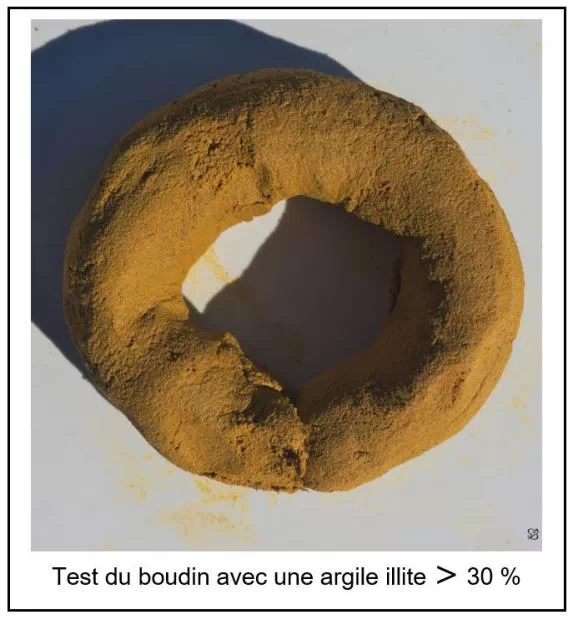
The roll test can be used to determine the approximate clay content of marl. After mixing a sample of marl that is moist enough to form a compact ball (moisture content comparable to that of clays used by potters), try to fold the roll to form a circle.
A few small cracks before the roll breaks, forming a semicircle, indicate that the clay content is around 15 to 20%. If cracks appear three-quarters of the way around before the roll breaks, the clay content is estimated to be between 20 and 30%.
If a complete ring can be formed without breaking, the clay content is greater than 30%. The reliability of this test depends on how the clay has been prepared and on certain impurities it may contain. Insufficient moisture, superficial mixing leaving small cracks and/or the presence of tiny organic fibres will distort the result.
Where can I find clay to improve the soil for cultivation?
There is a map of France showing areas of exposed or sub-exposed clay that are likely to cause shrinkage and swelling, which can be viewed by clicking here. Clay formations are ranked according to the intensity of soil shrinkage that may affect buildings. These areas, which pose a risk to buildings, also contain clayey marl (a mixture of carbonates and clay minerals) which produces the same effects. It should be noted that clayey marl is often used by farmers as a soil improver due to its high clay content (35 to 65%). For extraction permits, please consult the landowners and local regulations.
Clay is available commercially at all price points and in different colours depending on the minerals it contains, with the most expensive types being used in cosmetics. Some clays are used in arboriculture, fish farming, the manufacture of cat litter, as fired (bricks) or unfired (plaster) building materials, etc. Clays combined with fibres are used as building materials. They often contain a little fine sand, barley or flax straw, lime, and are recyclable and compostable. In principle, cob should have a maximum clay content of 30%, above which the mortar cracks when drying.
Some websites offer bentonite or montmorillonite clay for agricultural use, to be spread at a rate of 4 to 8 kg per 10 m², available by clicking here.
Soil cultivation and clay losses
Clay is not eternal. It can undergo displacement movements depending on the texture, structure and chemistry of the soil. If a continuous pore system exists in the soil, percolating water can transport clay particles downwards. This movement accelerates when the soil shrinks and cracks during dry seasons followed by rainfall. Clay accumulates when water movement is halted by an obstacle. Clay particles can then redeposit at depth to form thin layers of clay called argilans.
Clay particles can also be destroyed by chemical processes involving hydrogen ions, with the release of aluminium and silica. In this case, the pH of the soil beneath the topsoil is often lower. It is therefore necessary to replenish the clay from time to time, depending on the extent of the losses observed in laboratory analyses. Ploughing, because it turns the soil, is also a very effective way of limiting clay losses.
The most well-known types of clay
Clays are sedimentary rocks composed of very fine grains containing at least 50% aluminium silicate. They absorb water to form an impermeable paste commonly known as clay. Clays often contain various minerals such as iron oxides, which give them their distinctive colour. Clays are divided into several families according to their chemical and physical characteristics.
Below is my personal classification of certain clays, taking into account their origins and possible uses in agriculture. For each type of clay, I highlight two characteristics that are important for agriculture: their water absorption capacity (useful information for irrigation) and their CEC level (for fertilisation potential.

Illite jaune. Origine : Provence
Illite
A fairly common type of clay consisting of moderately tightly packed layers found almost everywhere. It is composed of three layers of phyllosilicates. Rich in iron (9%) and moderately rich in silica (36.5%), it also contains alumina (9%) and calcium compounds (14%).
It has low absorption capacity. Green illite clay is mainly extracted in the Paris Basin, the Massif Central and Provence. Its CEC varies between 10 and 40 meq/100 g. Yellow illite clay, used in cosmetics and extracted from quarries in Provence, has an ion exchange capacity of around 32 meq/100 g.
Kaolinite
White clay organised into tightly packed sheets consisting of two octahedral and tetrahedral layers of hydrated aluminium silicate. There are several forms in this group of clays, the best known of which are endellite, nacrite, alloycite and kaolinite itself. Kaolinite is used in the manufacture of porcelain. It mainly contains silica (48%) and alumina (36.5%). Known for its ability to regulate soil pH. It is extracted in the Limoges region, in the Drôme (Larnage and Rochefort-Samson) and in Provence. Their absorption capacity is moderate and their CEC is between 3 and 15 meq/100 g. Some kaolinites have a high CEC due to the smectite layers on the surface of the kaolinite crystals. Kaolin, a variety of kaolinite, is extracted from quarries in Provence and is used in cosmetics.
Argile montmorillonite verte. Origine : Provence
Montmorillonite
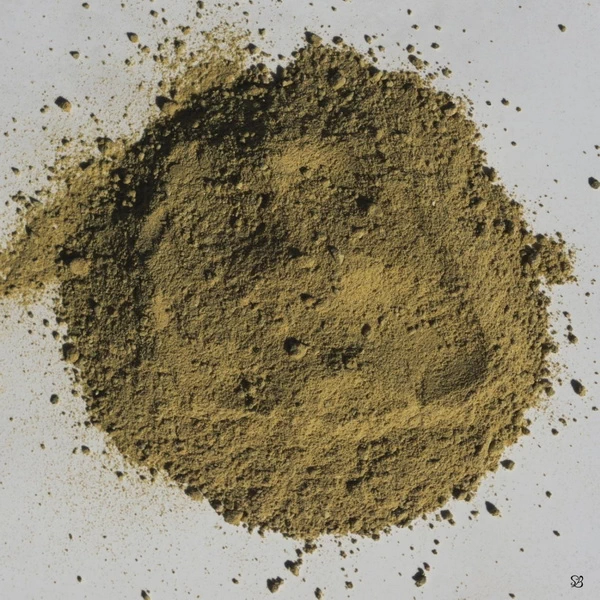
Also known as Terre de Sommières or Terre de Carpentras, this is a swelling clay characterised by separate layers and high absorbency. It contains high levels of silica (48.25%), alumina (11.17%) and magnesium (9.66%). Green montmorillonite, also known as fuller’s earth, has the highest adsorbent capacity of all clays.
In France, it is extracted from the Mormoiron mine in Vaucluse (also known as Provence green clay) or from Montmorillon in Vienne. It is also found in Languedoc. The CEC of montmorillonites is estimated at between 40 and 70 meq/100g, or even much higher depending on the source of extraction; more than 92 meq/100g for some commercially available montmorillonites. Montmorillonites are used in a wide range of industrial, medical and cosmetic applications due to their structure and physical and chemical properties.
Bentonite
A natural mixture of several clays, including montmorillonite (approximately 70%), which come in different colours. The term bentonite refers to clays that are often used in industry due to their high absorption capacity (20 times their volume in a wet environment). Bentonites are mixed with sulphuric or hydrochloric acid to meet specific industrial needs such as the clarification of edible oils. Bentonite has the ability to regulate pH through its buffering role. It improves the structure of sandy and loamy soils and is very suitable for forming absorbent complexes with humus. The CEC of bentonite can reach 90 meq/100 g depending on the source of extraction. Bentonites with a CEC greater than 95 meq/100 g are sought after in the paper industry. Some cat litters are made from bentonite
Hormite
group of clays to which palygorskite (also known as attapulgite by manufacturers) and sepiolite belong, both of which have been used for many decades for their high absorbency (150 to 300 m²/g), which is superior to that of montmorillonite (50 to 80 m²/g) (1). Significant deposits of hormite are found in China, Senegal, Spain, Ukraine and the United States. All of these deposits consist mainly of palygorskite, with the exception of the large sepiolite deposit in Spain. The CEC of hormite is between 30 and 40 meq/100 g. Some cat litter is made from 100% white hormite. It is also used in garages to absorb oil spills, or as a carrier in certain agricultural products (e.g. seed protection through coating).
1) CLAY SORBENTS: THE MINERALOGY, PROCESSING AND APPLICATIONS – Haydn H. MURRAY – Indiana University, Department of Geological Sciences, 1001 E. Tenth Street, Bloomington, Indiana 47405 USA