

Introduction to integrated methods in the vegetable garden
The site is organized into chapters and articles accessible by clicking on one of the titles in the menu located at the top of each page. Articles belonging to the same chapter are listed in a box located to the left or at the bottom of the header for smartphones.
chapter crop sol
Analysis of the physico-chemical properties of cultivated soils
Click on ♦ to go to a page in the chapter
⇒ Analyse of the physico-chemical properties of cultivated soils
. Texture and structure of cultivated soils ♦
. Clay-humus complexes and cation exchange capacity ♦
. Other interesting data that may be included in a laboratory analysis ♦
Influence of pH on the fertility potential of cultivated soils ♦
Humus; formation and evolution ♦
Soil fertility: is the apocalypse coming tomorrow? ♦
The microbial world and soil fertility ♦
Rhizosphere, mychorizae and suppressive soils ♦
Correction of soils that are very clayey, too calcareous or too sandy ♦
stimation of humus losses in cultivated soil ♦
Compost production for a vegetable garden ♦
Composting with thermophilic phase ♦
Weed management in the vegetable garden ♦
To plow or not to plow? ♦
The rotary tiller, the spade fork, and the broadfork ♦
Please share this website with your friends and family and anyone else who might be interested in integrated farming methods.
Physicochemical characteristics and fertilisation potential of a cultivated soil
Before getting out the spade and rake, I strongly advise all novice gardeners to assess the physical, chemical and biological characteristics of their garden soil using a laboratory analysis to determine its fertility potential and the crop systems it can support. This analysis also reveals any pollutants and the level of heavy metal contamination that may be present in the soil.
It is easy to find descriptions of rudimentary experiments (sausage test, bottle test, leaching test, test for the presence of organic matter using hydrogen peroxide, etc.) on websites or in books specialising in gardening, which can indicate whether garden soil is rich in clay, or the proportions of clay and other elements. These experiments are not very accurate and do not provide any information on the fertilising value of the soil. Certain important biochemical characteristics can only be determined through analyses carried out by a laboratory approved by the Ministry of Agriculture. These analyses, carried out according to standardised protocols, aim to establish a set of basic analytical data without which it is very difficult to take the appropriate measures to improve soil fertility and correct any deficiencies.
A soil analysis carried out by a laboratory specifying the soil’s particle size, organic matter content, pH value, and iron and manganese content already provides a wealth of interesting data. However, more precise measurements are needed to determine the amount of nutrients that a soil is capable of retaining from absorbent complexes. Certain deficiencies are impossible to detect without a more in-depth analysis of the various elements present in the soil and their interactions. These deficiencies are often the cause of problems encountered in a vegetable garden, such as the prevalence of certain diseases or the production of stunted crops.
There are two forms of deficiency :
– True deficiencies: One or more mineral elements are not present in sufficient quantities in the soil.
– Les carences induites : Induced deficiencies: There are sufficient minerals in the soil, but their assimilation by plants is blocked :
- Either through the presence of another element in excess, such as magnesium blockage due to excess potassium, zinc blockage due to excess phosphoric acid, potassium blockage due to excess calcium, or iron blockage in overly calcareous soils.
- Either due to climatic conditions such as boron deficiency following a drought.
- Either an element is downgraded and stored in a non-assimilable form, which is often the case with phosphorus.
- Either because the pH is too acidic, leading to reduced absorption of magnesium and molybdenum, or too alkaline, causing, for example, a deficiency in trace elements.
Every plot of land has a cultivation history consisting of fertiliser inputs and crop outputs (a), which means that the amount of fertiliser remaining in the soil must be assessed before new crops are planted. Similarly, when land has not been cultivated for a long time, its fertility can only be accurately assessed through laboratory analysis. This is also the case if cultivated land has never been subject to such a study. These analyses must be carried out at least every five years, a period that may be reduced following major changes decided by the gardener to correct the physical and biological characteristics of the soil.
Possible interactions between the various elements present in cultivated soildans
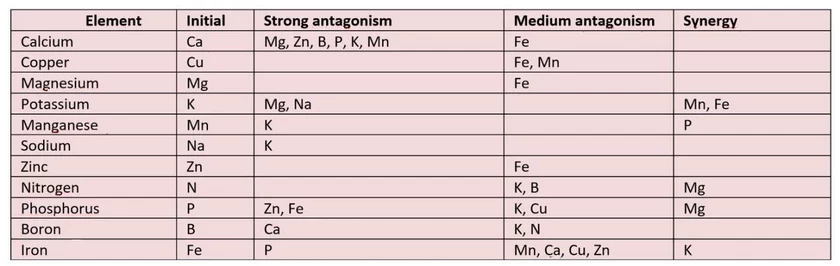
Source : tableau recomposé à partir de données de la conférence base 5-3-2013 – Biodiversité, Agriculture, Sol & Environnement
This more precise approach to fertilisation, commonly used in integrated farming, is often referred to as “fertilisation reasoning” or “input reasoning”
The surplus of inputs (b) remaining in the soil must be taken into account if it is quantitatively significant before importing new fertilisers. This surplus requires a reduction in fertilisation for each element in excess.
These tips may seem excessive to an amateur gardener who plans to maintain a small vegetable garden. However, I know gardeners who lament the fact that some of their vegetables are stunted or frequently fall victim to disease. Gardening can be an interesting hobby, especially as a way to combat the sedentary lifestyle that has become a real scourge in today’s world. But how much effort is wasted, leading to discouragement, if the expected results are not achieved! A comprehensive analysis of the soil’s characteristics is only necessary once. Its cost will quickly be recouped by the plants’ increased resistance to disease and higher yields. Above all, you will avoid embarking on dubious or even dangerous treatments due to a lack of sufficient information about the physical and biological characteristics of your vegetable garden’s soil.
a) Exports refer to mineral salt losses following harvests.
b) In agriculture, inputs refer to everything that is introduced into the agricultural production process: fertilisers, plant protection products, compost and other soil improvers, seeds, etc….
Some examples of deficiencies encountered in agriculture, with indications of external signs and corrective inputs.
Nitrogen deficiency encountered in agriculture.
Plants are stunted with delayed growth, displaying pale green to yellow leaves that eventually fall off. Generalised chlorosis often indicates nitrogen deficiency. Fruiting often occurs early, as if the plant has decided to reserve all its resources for the production of a few seeds in order to preserve its species. Leafy vegetables are particularly sensitive to nitrogen deficiency. This deficiency can be easily corrected by applying potassium nitrate (when the potassium content in the soil is not excessive) as a foliar spray or directly to the roots during watering, or by applying granular urea or ammonium nitrate before watering (slightly longer reaction time).
Phosphorus deficiency encountered in agriculture.
In vegetable farming, phosphorus deficiency is most noticeable in legumes and fruit vegetables such as tomatoes, cucumbers, aubergines, and certain root vegetables such as potatoes and beetroot. This deficiency is characterised by stunted plants and delayed flowering. Older leaves are dark green before turning purple. The tips of the leaves may also turn dark green and the stems may take on a reddish colour. The fruits are small and few in number. To correct this deficiency, add a little assimilable phosphorus to the growing soil before planting or to compost before spreading, such as Solabiol’s “natural phosphate”.
Potassium deficiency encountered in agriculture.
The plant is limp, indicating a lack of turgidity (water deficiency within the cells). The stems and leaves wilt easily and suffer from marginal necrosis, which can be confused with magnesium or copper deficiency. The leaves then take on a reddish or brownish colour. The leaves are often affected by chlorosis, which spreads gradually from the edges towards the centre. Tomatoes, legumes and beetroots are very sensitive to potassium deficiency, which occurs more easily in acidic soils. This deficiency can be quickly corrected by adding potassium nitrate in the same way as for nitrogen deficiency, unless the latter element is too abundant.
Iron deficiency encountered in agriculture.
This deficiency manifests itself in slowed growth, yellowing of the leaves without reaching the veins, or brown spots on certain plants with leaf fall. This deficiency, which is common on calcareous soil, can be corrected each year by applying iron sulphate. However, as its action is slow to take effect (around 6 months), it is recommended that this deficiency be corrected in the first year by spraying iron chelate onto the foliage. There are liquid products available for rapid treatment of iron deficiency in the soil, such as Spinach H36 from Aprochim.
Other possible deficiencies and confusions.
Scattered yellowing in the form of beads affecting older parts indicates a magnesium deficiency. Chlorosis of young organs indicates a calcium deficiency, which can be confused with iron deficiency. A sulphur deficiency is characterised by chlorosis of the leaves; the veins are generally lighter in colour than the interveinal tissue. Chlorosis of these veins indicates a magnesium deficiency, which can be confused with a manganese or iron deficiency. A copper deficiency causes discolouration of the leaf tips. Root necrosis indicates a boron deficiency, which can be confused with a micro-worm infestation
For the P.A.C.A. region in France, one of the nearest laboratories approved by the Ministry of Agriculture is located at the following address: Laboratoire Développement Méditerranéen (UDM) – 8 chemin des 2 Mas – Pist 4 – 30100 ALES – Tel: 04 66 61 02 97 – E-mail: laboratoire.ldm @wanadoo.fr – Website: click here. For other regions of France, the list of laboratories approved by the Ministry of Agriculture in 2021 can be found here.
The Mediterranean Development Laboratory offers a series of analyses presented in an information sheet available on its website for different situations (arboriculture, viticulture, field crops, gardening, etc.). An information sheet explains how to prepare a soil sample for mailing. The soil analysis includes a granulometric analysis, which is only carried out once, unless you wish to change the texture of the soil by adding appropriate amendments. Data on microbial biomass, microbial activity and the granulometric fractionation of organic matter can also be obtained, but the price of the analysis will be higher.
The analysis sheet is accompanied by a page of comments on the physical, biological and chemical characteristics of the soil, with fertilisation advice. In order to obtain accurate measurements, I strongly advise you to tick the box for measuring the total nitrogen content of the soil, without which it is difficult to obtain accurate information on other parameters.
For example, you will receive an annual estimate of humus loss, which is important information for determining the volume of organic matter to be added each year, or the maximum mineral nitrogen supply to be added, expressed in U/ha (U = unit of measurement in kg of a pure element per hectare). Please note that not all laboratories offer such a comprehensive analysis. Some important data is not specified, such as the ratio between certain elements, which may be the cause of certain induced deficiencies.
Thereafter, every five years, you can request a new, less expensive analysis to obtain some of the most useful data, such as humus and essential element reserves (potassium, phosphorus, magnesium, boron, etc.), the carbon/nitrogen (C/N) ratio, cation exchange capacity (CEC), and the specific ratio between certain elements. It should be noted that between two laboratory analyses, interesting data on the evolution of your soil’s characteristics (pH, nitrate content) is available to gardeners, provided they purchase the necessary laboratory equipment and consumables (testers, test strips), which, depending on the equipment chosen, can be used for several years and is not necessarily expensive. This equipment is described in the following pages of this website
Cultivation soils; limitations of laboratory analyses
Laboratory analyses are carried out on a sample of fine soil, and certain parameters cannot be taken into account. With regard to soil texture, particles smaller than 2 μm are considered to be clay, even though they may contain fine limestone elements. The clay content is therefore often overestimated. However, other laboratories show fine limestone particles separately in their reports. This is also the case for particles measuring 0.050 mm to 2 mm, which are classified as “sand” even though they are not composed solely of silica, which inevitably has an impact on the physical and biological properties of the soil. The binding capacity of cations (potassium, calcium, magnesium) and certain anions (phosphate, iron hydroxide, etc.) varies depending on the type of clay. The CEC measured on the same sample with different control cations can vary significantly (1).
It is commonly accepted that the C/N ratio is also an indicator of soil biological activity. A high ratio (greater than 12) would indicate reduced, disturbed biological activity. A C/N ratio below 10 would indicate active biological activity. However, the introduction of long-lasting humus with a high C/N ratio and containing certain humic acids is characterised by reduced annual nitrogen consumption and an increase in CEC.
Laboratory analyses are sometimes disparaged because of their limitations related to analytical techniques. The techniques used by laboratories can sometimes conceal biases that alter the conclusions.
Some critics of laboratory analyses prefer to focus on field observations: how plants evolve, their appearance, diseases diagnosed by visual inspection, etc. However, there is no good science without measurements. For example, in the case of a deficiency resulting in abnormalities in certain plants, how can we know whether this is induced or real without laboratory analysis? Furthermore, it has long been known that the absence of symptoms does not necessarily mean that there is an optimal balance of mineral elements (2).
1) Légifrance ; Arrêté du 18 décembre 2024 fixant la liste des laboratoires d’analyses de terre agréés pour l’année 2025 ♦
2) Ravina et Gurovich, 1977 ; Amacher et al., 1990
3) Symptômes et diagnostic des carences alimentaires ; Trocmé – phytoma N° 159 juin 1964
Laboratory analysis of cultivation soils; next page :