

Introduction to integrated methods in the vegetable garden
chapter crop sol
Humus; formation and evolution
Click on ♦ to go to a page in the chapter
Analysis of the physico-chemical properties of cultivated soils ♦
. Texture and structure of cultivated soils ♦
. Clay-humus complexes and cation exchange capacity ♦
. Other interesting data that may be included in a laboratory analysis ♦
Influence of pH on the fertility potential of cultivated soils ♦
⇒ Humus; formation and evolution
Soil fertility: is the apocalypse coming tomorrow? ♦
The microbial world and soil fertility ♦
Rhizosphere, mychorizae and suppressive soils ♦
Correction of soils that are very clayey, too calcareous or too sandy ♦
Stimation of humus losses in cultivated soil ♦
Compost production for a vegetable garden ♦
Composting with thermophilic phase ♦
Weed management in the vegetable garden ♦
To plow or not to plow? ♦
The rotary tiller, the spade fork, and the broadfork ♦
Please share this website with your friends and family and anyone else who might be interested in integrated farming methods.
Origin of humus
Humus comes from the decomposition of dead organic matter commonly referred to as fresh organic matter (FOM) from forests or agricultural activities. This organic matter is used by a variety of soil organisms as a source of energy and material for building their cell structures and reproduction. During this process, various organic compounds such as starches, sugars, proteins, cellulose, lignins and resins are transformed by a process known as mineralisation to form simpler compounds that can be assimilated by plants or enter into other processes leading to the formation of humus.
Studies conducted over the past fifty years on humus have highlighted physicochemical properties that are particularly interesting for agriculture: increased water retention capacity, favourable effect on soil structure, stimulation of microbial activity, improved root exploration, easier absorption of fertilising elements, release of nitric nitrogen, etc. However, not all humus is suitable for agriculture. Some types are too acidic or too rich in carbon. Only mull-type humus, properly prepared using compost or soil-preserving cultivation techniques, is considered essential for maintaining or restoring fertility.
Most common classification of organic materials
Living Organic Matter (LOM)
As the name implies, it includes all forms of living organic matter of animal or plant origin, including plant roots, microflora, earthworms, fungal mycelium, etc. LOM represents only 1-3% of total soil organic matter.
Fresh Organic Matter (FOM)
refers to all dead organic matter of plant and animal origin including rapidly decomposing materials. FOM includes all more or less fractionated elements that can be easily identified. Because of their short life span, FOM represents only a small part of the total organic matter of the soil (about 20%)
Stable Organic Matter (SOM or HM for Humic Matter)
is derived from the above substances and is commonly referred to as humus. Humus is made up of long and complex molecules that are often closely linked to mineral matter. Humus is not strictly speaking the final residue of decomposition. Humification is characterised by the formation of larger and larger molecules from the simpler residues of decomposing SOM. The soil microflora is not only responsible for this humification. Chemical and physical processes (polycondensation, polymerisation, inheritance humification characterised by reduced lignin decomposition) are also involved. Humus has different fine structures depending on the initial composition of the plants, without recognising their origin with the naked eye. Humus is a colloidal substance that is insoluble in water and has the consistency of a soft, airy, dark-coloured material with a characteristic odour. As their life span can be several decades, or even several hundred years under specific conditions, humus accounts for about 80% of the organic matter in soils.
The role of surface and underground litter in humus formation
In a forest, humus loss is compensated for by the addition of new organic matter from plants (leaves, dead branches) and animal faeces. These additions form an initial layer of organic matter at various stages of decomposition, known as surface litter (horizon O of the soil reference system). It is an important source of energy for all beneficial organisms, including insects, earthworms, fungi and microorganisms that contribute to its decomposition. The thickness of this litter varies depending on the nature and density of the forest and the local climate.
Soil profiles and horizons
In pedology, horizons refer to layers of different structures found in a soil profile called solum. The profile is the sequence of information located from top to bottom of a horizon designated by a letter. The reference horizons are listed in a list established by the French Association for Soil Studies (AFES). These horizons are classified into groups and sub-groups according to the evolution of pedogenesis (the history of the soil) and the proportion of certain constituents. The horizons that are most relevant to agriculture are as follows:
Horizon O: In relation to the surface, this horizon describes the first layer corresponding to different degrees of decomposition of organic matter. Horizon O coincides with the surface litter found in forests, consisting mainly of more or less organised organic matter (branches, dead leaves, animal excrement, etc.)
Horizon A : also called “topsoil”, this horizon is located below the O horizon. It consists of a mixture of mineral matter and well-decomposed organic matter, much of which is transformed into humus.
Horizon L : corresponds to the ploughed area to which allochthonous elements have been added, modifying its initial characteristics (fertiliser, soil improvers, etc.).
Horizon S : Lighter in colour than horizon A, it contains smaller quantities of organic and mineral elements from horizons A or L, including mineral salts that can be assimilated by plants. This horizon was formed by the alteration of primary minerals, releasing clays in particular. It is from this underlying layer, which varies in thickness, that the deep roots of certain plants draw nutrients from the weathering of the parent rock (designated by other letters and which may be hard or loose or composed of scree or other materials).
In regularly ploughed soil, the L horizon has a uniform colour that contrasts with the underlying layer. The upper part of this underlying layer is called the plough pan.
The constant renewal of fine roots produces underground litter that accounts for 92% of the biomass in the subsoil. This litter is often very thick near trees. This is easy to see in public gardens by observing the ground surface beneath trees during the wet season. The ground surface is often covered with small mounds of earth called turricules, which are produced by earthworms feeding on this natural organic litter.
In fields or vegetable gardens, surface litter is often minimal or even absent. Farmers must therefore add shredded or composted crop residues or manure in order to maintain the soil’s humus reserves. These surface residues often account for 50% or more of the organic matter in cultivated soils. In the PACA region, where a lot of durum wheat is grown, carbon-rich straw is often shredded before being buried in order to replenish humus reserves.
The underground litter produced by crop roots also contributes to maintaining the humus pool. This underground litter is often underestimated because it is not visible. However, cultivated plants fix enormous amounts of carbon, especially when their crop cycle is optimised by fertiliser and adequate irrigation. Some of the carbon is exported by the harvests. The rest is found in surface residues (such as straw) and in the roots.
Plant roots are usually covered with root hairs (radicles) that are invisible to the naked eye and form a large surface area that promotes the absorption of water and mineral nutrients from the soil. These root hairs are fragile and disappear quickly.
A single winter rye plant can produce 620 kilometres of roots in just 0.5 cubic metres of soil (4). These root hairs are constantly renewed to compensate for losses. It is not easy to estimate the biomass of plant roots because the volume of rootlets is difficult to sample. Nevertheless, as a general rule, plants allocate more biomass to roots if the limiting factor for growth comes from the subsoil (e.g. water), while they devote more biomass to above-ground parts if the limiting factor is above ground (e.g. reduced light caused by obstacles such as taller plants).

Jardin public d’Oraison ; Turricules de vers laboureurs
Quantités d’humus stable produites par les racines de quelques grandes cultures
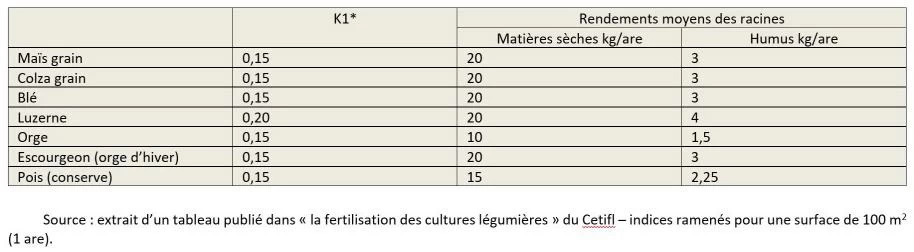
*For the definition of K1, see below
These figures show that between 1/5 and 1/8 of the dry matter in the roots is converted into humus
Stable humus quantity provided by crop residues from certain vegetables, taking an average K1 of 13.5* (based on data extracted from A; Anstett “Humus levels in soils” 1962); table published in “Fertilisation of vegetable crops” by CTIFL – indices calculated for an area of 100 m² (1 are).
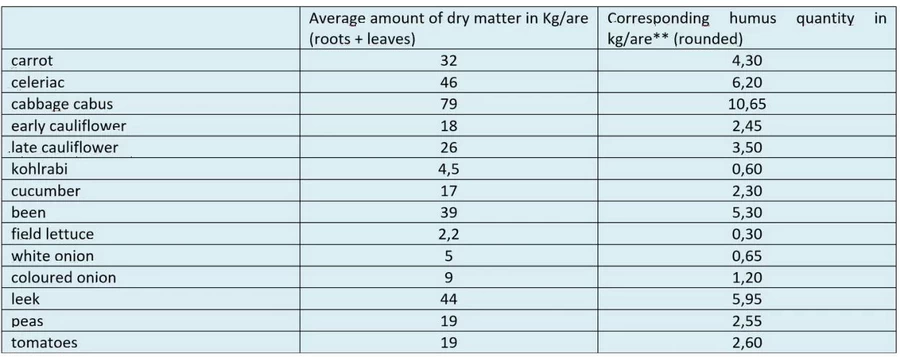
** This figure is the result of multiplying the average quantity of dry matter in kg/acre by K1, i.e. 13.5 in this case; example: carrot 32 x 13.5 = 4.32
The indices in this table show that vegetable crop residues produce little stable humus, which must therefore be supplemented by other inputs when seeking to correct annual humus losses (for the calculation of annual losses for an area of one are, see. here).
The most well-known types of humus
The mull
Refers to slightly acidic humus found in forests containing many deciduous trees. Many earthworms contribute to biological activity. Surface litter is decomposed within a year. This humus is characterised by its high nitrogen content (C/N = 10 to 15). The soil structure, rich in clay-humic complexes, has a granular structure. A variant, carbonate mull, which originates on calcareous soils, has very interesting biological characteristics that can be reproduced in agriculture on identical soils by adding organic amendments or using soil conservation cultivation techniques such as direct seeding.
Humus is strongly bound to clay by calcium bridges, producing highly flocculated structures. Rendzinas are humus rich in magnesium carbonate and iron, black in colour in forest areas and reddish if iron is very present. In mountainous areas with rich deciduous vegetation, the humid and cold climate promotes the accumulation of humus to form humus-calcareous soils.
The moder
This type of humus forms on poorer soil characterised by thick litter that is home to less diverse flora and fauna. The surface litter often consists of a mixture of leaves and needles, with a predominance of fungal filaments. The bacterial population is less numerous. The colour of moder is very dark. Its pH is acidic (< 5) and the C/N ratio varies from 15 to 25. Rankers are nitrogen-poor moder-type humus that can evolve over time by fixing calcium, potassium, iron hydroxide and aluminium ions from the bedrock, becoming less and less acidic.
The mor
This type of humus is found on siliceous soils where many conifers or heather grow in harsh environments (high mountains, rocky areas along certain coastlines, sandy soil, boreal zones, etc.). The soils are very acidic with low biological activity. Surface litter decomposes very slowly. The pH can drop to 3.5 and the C/N ratio is greater than 20. Due to its high acidity, this type of humus lasts a very long time and can accumulate and evolve in certain regions to form layers of infertile humus.
Agricultural humus
Humus in grasslands and cultivated areas is linked to human activity. Compared to cultivated areas, grasslands are often richer in humus. The quality of agricultural humus depends on several factors, not all of which are anthropogenic, such as climate. The nature of crops, tillage and organic inputs are factors that alter the content and qualities of this humus to a greater or lesser extent. Poor soil maintenance leads to a reduction in humus, while good agricultural practices have the opposite effect.
There are very specific and very ancient types of humus linked to human activities, such as the black soils of Brazil (terra preta), which are exceptionally fertile and consist of a high concentration of charcoal, organic matter and nutrients mixed with pottery shards.
Composition and evolution of humus
Humus contains complex organic acids, notably fulvic acids (low molecular weight, soluble in acidic or basic reactions), humic acids (higher molecular weight, insoluble in acids and alcohols), and humin (an extremely stable substance with a high molecular weight consisting of various interlinked products that are insoluble in all solvents). Humin accounts for 50 to 70% of humus.
Fulvic acids are known to break down parent rock, thereby helping to increase the resources of minerals useful to plants. These organic acids also have the advantage of increasing the availability of phosphorus.
As for humic acids, due to their flat, interconnected structures, they improve water retention in the soil (approximately 16 times their own weight). Like fulvic acids, humic acids can form compounds with metal ions (chelation), particularly iron and copper, or with other ions to form food reserves for plants. In addition, humic acids play an important role in the degradation of pesticides and their metabolites present in the soil.
Humus mineralisation is mainly dependent on the microbial biomass in the soil. Aeration, temperature and soil moisture are key factors in humus mineralisation. Compared to organic fertilisers, humus mineralisation is slower and contributes little to the enrichment of cultivated soil with mineral salts. This contribution is usually negligible for long-lasting humus.
humus loss in cultivated land
Agricultural humus, like all other types of humus, is not eternal. It is gradually mineralised by micro-organisms (producing mineral salts and gases such as CO₂). Humus losses vary from 1 to 5% per year (1). Soil pH, ploughing depth, rainfall and climate are factors that contribute to varying degrees to humus loss. Warm, moist and aerated soils have high rates of humus loss. On the other hand, very dry and very warm soils lose less. Mountainous areas are also known for their very low humus loss, probably due to much longer cold periods than in plains and valleys. In general, tilled clay soil can lose 2% of its organic matter per year, while sandy loam soil can lose 4% (2). Without a constant supply of fresh organic matter or compost, humus will eventually disappear.
When organic matter contains plant debris rich in cellulose and lignin, their very slow decomposition contributes little to increasing the biological activity of the soil. The larger the particle size of the organic matter, the longer it will take for the carbon to be integrated into the humus pool. Tree bark and shredded tree branches will take more than a year to integrate into the humus pool. On the other hand, the yield of stable humus is higher than that of rapidly decomposing organic matter.
Preserving the humus content of cultivated soil is essential, especially since it can take a very long time to rebuild. In soil used for large-scale cereal cultivation containing 2% organic matter, this amount of humus present in a layer of topsoil 20 to 25 cm deep represents the product of the transformation of straw from a hundred years of cereal cultivation (3).
In order to predict the volume and nature of organic inputs, the estimated humus losses from cultivated soil are detailed by clicking here
Report C/N
The fertilising properties of humus are defined by the carbon/nitrogen (C/N) ratio. A C/N ratio of 20 means that humus contains 20 times more carbon than nitrogen. Nitrogen-rich plant debris produces humus with a C/N ratio of around 15. Plant debris containing a lot of cellulose produces humus with a C/N ratio often higher than 20 and is, in a way, poor humus. However, it is valued for its soil restructuring properties because it produces very stable agglomerates with clay. The lower the C/N ratio, the faster the humus degrades.
Nitrogen hunger
In a natural environment (forest) or artificial environment (fields, vegetable gardens, etc.), if there is too much carbon in fresh organic matter, microorganisms will consume a large part of the nitrogen reserves present in the soil, resulting in nitrogen deficiency for plants. This deficiency is also known as “nitrogen starvation”, which occurs when farmers spread organic matter that is too rich in carbon (e.g. straw that has not been turned into manure) on their fields. Nitrogen starvation is characterised by stunted plants and pale green foliage. However, this nitrogen is temporarily unavailable to plants. Some of this nitrogen will be restored when micro-organisms die as a result of the reduction in excess carbon. Soil that is too rich in carbon can be corrected by adding mineral nitrogen (e.g. pelletised urea, ammonium nitrate), the dose of which is determined by a nitrate analysis using laboratory test strips.
Coefficients K1 et K2
It is interesting to know the amount of humus produced from different types of fresh organic matter. The isohumic coefficient (or K1 coefficient) defines the stable humus content remaining after 3 years of burial of a given quantity of fresh organic matter. For each type of fresh material, the K1 coefficient applied to the dry matter specifies what will remain as stable humus. For example, for a K1 of 15, which corresponds to a green manure with a dry matter production rate of 20% relative to MOF, one tonne of MOF will produce 30 kg of stable humus. It is immediately apparent that green manure produces very little stable humus, whereas one tonne of well-decomposed manure with a K1 of 50 and 20% dry matter will produce 100 kg.
The K2 coefficient expresses as a percentage the rate of humus destroyed each year by mineralisation. Generally speaking, for market gardening crops, a humus loss of 2% is accepted in the north of the Loire and 3% in the south (5).
1) Magdoff et Weil, 2004
2) À McGuire – Can Manure Sustain Soils? – 7 février 2018 ;
3) Frayssinet – fertilisation organique des sols
5) La fertilisation des cultures légumières – Ctifl ; H Zuang – Edition 1982