

Introduction to integrated methods in the vegetable garden
chapter crop sol
Clay-humus complexes and cation exchange capacity
Click on ♦ to go to a page in the chapter
Analysis of the physico-chemical properties of cultivated soils ♦
. Texture and structure of cultivated soils ♦
⇒ Clay-humus complexes and cation exchange capacity
. Other interesting data that may be included in a laboratory analysis ♦
Influence of pH on the fertility potential of cultivated soils ♦
Humus; formation and evolution ♦
Soil fertility: is the apocalypse coming tomorrow? ♦
The microbial world and soil fertility ♦
Rhizosphere, mychorizae and suppressive soils ♦
Correction of soils that are very clayey, too calcareous or too sandy ♦
Stimation of humus losses in cultivated soil ♦
Compost production for a vegetable garden ♦
Composting with thermophilic phase ♦
Weed management in the vegetable garden ♦
To plow or not to plow? ♦
The rotary tiller, the spade fork, and the broadfork ♦
Please share this website with your friends and family and anyone else who might be interested in integrated farming methods.
Clay-humic complexes (CHCs)
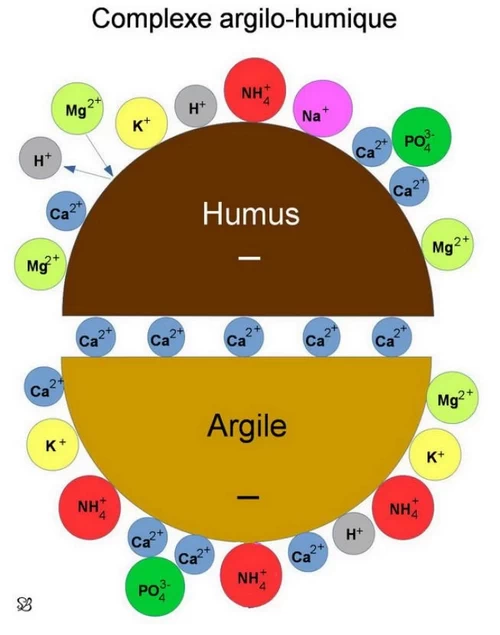
Certain elements of humus, particularly grey humic acids and humins, have the ability to bind with clay to form clay-humic complexes (CHCs), which are known to be very stable. Clay micelles and electronegative humus molecules are most often linked together by calcium cations. This type of bond slows down the mineralisation of humus.
The stabilisation of the whole is all the greater when the humic compounds are polycondensed, favoured by soil conditions that are neither too acidic nor too alkaline (1). These aggregates play an important role in soil structure by creating gaps between them that are filled with air and water.
CAHs are also known as “adsorbent complexes”, a term that encompasses other substances capable of retaining ions present in the soil solution on their surface.
The finer the clay micelles, the greater their retention capacity, which promotes stable bonds with humus. The negatively charged surfaces of CAHs attract positively charged ions (cations). Among the cations fixed by CHCs, Mg₂⁺ (magnesium), K⁺ (potassium), Ca₂⁺ (calcium), Na⁺ (sodium) and NH₄⁺ (ammonium) cations, which are nutrients for plants, are also retained. For this reason, CAH are considered to be nutrient reservoirs.
CHCs are declared saturated when all H⁺ cations are replaced by other cations. In soils that are commonly studied, the proportion of cations fixed in clay-humic complexes is often as follows: Ca²⁺ = 75 to 90%, Mg²⁺ = 10 to 30%, K⁺ and NH₄⁺ = 5 to 10%, Na⁺ = 2 to 5% (3).
Weak bonds in CHCs that allow cation exchange with roots
The bonds between the CHCs and the cations are weak enough to allow the cations to be retained in an exchangeable form. More specifically, a cation can only be released into a solution if there is another cation capable of replacing it and if the bond strength of the latter with the absorbing complex is stronger than that of the cation already bound. CHCs absorb cations in descending order of affinity, as follows: Ca₂⁺> Mg₂⁺> K⁺> NH₄⁺> Na⁺> (3). Exchanges take place until the electrical equilibrium of the medium is reached. Thus, the absorption by plant roots of cations fixed on CAHs is only possible if other cations replace them. These exchanges take place at the level of the rootlets.
An acidic environment destroys the bonds in clay-humic complexes.
In an acidic environment, H⁺ cations tend to replace other cations, including Ca²⁺ cations, which bind humus and clay, leading to the breakdown of the absorbent complex. To prevent this breakdown of CHCs. in calcium-deficient soils, calcium amendments must be applied as soon as possible. Lime can be used to quickly neutralise overly acidic soil, but it is prohibited in organic farming.
Nitrogen fixation by clay-humic complexes
Nitrates and chlorides are not retained by the adsorbent complexes. However, ammonium ions (NH₄⁺) are absorbed, which has the advantage of forming a reserve of nitrogen that can be assimilated by plants. It is worth remembering that nitrogen assimilation by plants occurs in two ways:
- Absorption of water-soluble nitrates in soil produced by the decomposition of organic matter and industrial nitrogen fertilisers (urea, ammonium nitrate, etc.). Nitrates are the most widely used source of nitrogen for plants.
- Absorption of ammonia through ion exchange between rootlets and clay-humic complexes located in contact with them. This is the only form of ammonia absorption by plants. This fixation of ammonia by clay-humic complexes has the advantage of limiting losses of this form of nitrogen through volatilisation.
The fact that highly soluble nitrates cannot be fixed on CHCs is a major problem in controlling nitrogen fertilisation, especially in organic farming, which prohibits regulating plant needs through the precise addition of nitrogenous mineral salts (see article: the problem of nitrogen assimilation in organic farming). Furthermore, ammonium cations compete with other elements (particularly calcium and magnesium), reducing the stock of ammonium cations fixed by HACs. As a result, the ammonium stock is often insufficient to meet plant needs during the most critical periods.
Clay-humic complexes and reduction of soluble element losses from fertilisers
If the soil solution is modified by the addition of fertilisers containing water-soluble elements, certain cations (Ca₂⁺, H⁺, etc.) will leave the clay-humic complex and be replaced by other cations from these fertilisers (except nitrates). It is clear that these properties are very important in terms of fertilisation. The way in which these nutrients are fixed by CHCs prevents them from being lost through leaching or leaching..
In very calcareous soils, there is often a high content of water-soluble calcium, which is further accelerated by the CO₂ produced by high biological activity following the addition of organic matter. This calcium ends up saturating the clay-humus complexes to the detriment of other cations such as potassium and phosphorus, which may then be lacking. This is why soils with too much calcium have difficulty retaining mineral fertilisers.
CHCs. and assimilation of phosphorus and potassium by plants
CHCs contribute strongly to the storage of phosphorus and potassium, which are important elements of soil fertilisation. A soil analysis every 3 to 5 years allows monitoring the evolution of this reservoir
Phosphorus reserve in absorbent complexes
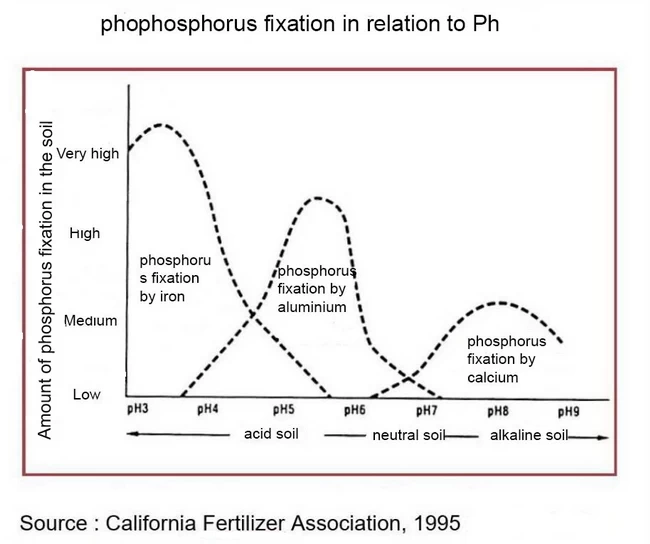
Phosphorus is present in the soil in organic or mineral form. The organic form comes from the degradation of organic matter, whereas the mineral form results either from the alteration of the parent rock (such as apatite, in which phosphorus is associated with calcium), or from the recombination of phosphate ions present in the soil solution with iron, calcium or aluminium to form phosphates that are insoluble in water.
This retrogradation phenomenon is more important in very calcareous or very acidic soils and is accentuated by high summer temperatures or when phosphorus is concentrated on the surface. Furthermore, in relation to a pH value < 7 or > 7, insoluble phosphorus salts will have different properties.
In acidic soils, phosphate ions react easily with aluminium and iron to form more stable compounds than the solid phosphate compounds that form in alkaline soils. This leads to a real blockage of phosphorus in acidic media, which can be reversed by liming to increase the pH
Since solid phosphates cannot be assimilated by plants, they end up accumulating in the soil and represent 95% of the total phosphorus reserve in the soil.
The different forms of phosphorus uptake by plants
Plants have access to phosphorus from the following 4 sources:
- By assimilation of phosphate ions present in the soil solution, these ions coming from the parent rock or from organic fertilizers. Phosphorus can only be assimilated by the roots when it is in the form of ions present in the soil solution. This soluble phosphate is in dynamic equilibrium with orthophosphate fixed in solid compounds. This equilibrium is characterised by a very small amount of soluble phosphorus of the order of 0.1 to 0.4% of the total phosphorus present in the soil. This form of phosphorus uptake is therefore not very profitable. The concentration of orthophosphate ions in the soil solution depends on the pH, which affects the solubility of complexes formed with other elements. As soon as phosphorus disappears from the solution (absorbed by plant roots), it is replaced by drawing on the reserves of phosphorus fixed in the soil until the dynamic equilibrium between free phosphates and phosphates blocked in the soil is restored.
- By chemical processes to make a phosphorus salt soluble in water. The dicalcium phosphate found in industrial fertilisers under the name of “phosphate soluble in ammonia citrate” is directly assimilated by plants.
- By taking up phosphate ions stored in exchangeable form in the adsorbing complexes. For this, the soil must be rich in CAC. The phosphate ions are then returned to the plants when they need them. Phosphate ions that are not absorbed by the plants are stored via calcium ions attached to the CAC. The positively charged calcium ions form a bridge with the negatively charged phosphate ions. In soils rich in absorbing complexes and especially CAC, this form of phosphate represents about 5% of the total mass of phosphate present in the soil and this reserve is available to the plants when it is close to the rootlets.
- Phosphorus is released by fungi and bacteria such as Bacillus Amyloliquefaciens, which is a strict aerobic bacterium living in the soil. This microorganism, which colonises plant roots, generates a phytase enzyme that enables it to release organic phosphates from the soil. Mycorrhizal fungi, which thrive in symbiosis in plant roots, contribute up to 90% of the tricalcium phosphate absorption of mineral fertilisers when the soil contains sufficient calcium ions (4).
Organic matter and phosphorus release for crops.
It is obvious that a good supply of CHCs is necessary to allow a progressive assimilation of phosphates without forcing with fast-acting chemical fertilizers or nervous organic fertilizers. This is especially true since a massive supply of soluble phosphate is not necessarily the right solution when the soil is deficient in humus, as phosphates are rapidly fixed with iron and calcium to form new insoluble compounds. Very often, the reserves of phosphates blocked in the soil are sufficient to meet the needs of the plants. It is sufficient to release them by adding humus to a soil with a good clay content.
The potassium reserves in the absorbent complexess
Potassium is present exclusively in 3 mineral forms in the soil :
- It is part of the minerals of the parent rock (micas, feldspars), or it is trapped in clay sheets. Depending on the nature of these clays, potassium fixation is more or less high. It is the most abundant form, but its release is very slow.
- It is present in the exchangeable form on the surface of clays and CHCs.
- It is in solution in the soil water.
Potassium losses in cultivated soils depend on clay and organic matter content.
Potassium is a more or less mobile element depending on soil characteristics. Leaching is limited when soils are well maintained and rich in CAC. It is more important in sandy soils poor in humus or with low clay content. Losses can be as low as 1 kg potassium ha/year if the soil contains 24% clay and as high as 46 kg ha/year when the soil contains only 5% clay (5). The reserves of exchangeable potassium fixed by the adsorbing complexes can be multiplied by up to 23 depending on the type of soil (6).
Cation exchange capacity (CEC)
Apart from CHCs, there are other elements in the soil, in particular free clays (kaolites, montmorillonites, Illites…) or absorbent elements brought by the gardener (zeolites, blond peat…) which are able to retain cations. The Cation Exchange Capacity (CEC) is an indicator of the potential for fixing and storing cations that all absorbent complexes are capable of storing and releasing. The CEC depends on the clay and organic matter content and the composition of the clays. Other materials have a negligible influence on CEC (a).
As far as clays are concerned and to give some examples, humus has an exchange capacity 30 times higher than kaolites, 10 times higher than illites, 3 times higher than montmorillonites.
Exchangeable bases
Exchangeable bases, an expression often encountered in agronomy studies or laboratory analysis reports, are cations (notably K⁺ Ca₂⁺ Mg₂⁺ Na⁺) fixed on clay-humus complexes and other colloidal substances that can be exchanged with those present in the soil solution. For these nutrient reserves, a laboratory analysis should at least specify the values found in relation to an optimum as well as the saturable absorption rate (SA/T) (T/S in french) of the adsorbing complexes. The latter can retain strongly-bound substances such as strong acids that prevent cations useful to plants from binding to the uptake sites. The SA/T ratio gives the saturation level of weak acids (corresponding to the useful cations that can be adsorbed) that an adsorber complex is capable of binding. For example, a SA/T of 60 indicates that 60% of the sites in the complex are used to bind weak acids, with the remaining 40% taken up by strong-binding elements..

Source : Agr’eau -2b – Objectifs – Analyser son sol pour mieux le connaître – Chambre d’agriculture de la Drome – nov 2013
CEC is expressed in laboratory analyses most often in meq/100g. This value specifies the number of ammonium cations (NH₄⁺) expressed in number of charges per 100 g (milliequivalents per 100g) that all the exchange sites of the CEC are able to absorb measured by automatic spectrophotocolorimetry.
The higher the CEC, the more cations can be adsorbed and released by the soil and made available to the roots. The CEC value is modulated by various factors such as the amount of calcium and the soil pH.
Most laboratories approved by the Ministry of Agriculture are able to carry out analyses to determine the CEC using a standardised method.
a) All minerals with extremely small particle sizes have a small CEC that forms at bond breaks. The CEC increases as the particle size decreases. But their exchange capacity due to broken bonds is insignificant
1) Le sol vivant Base de pédologie – biologie des sols – J.M. Gobat, M. Aragno, W. Matthey
2) Les facteurs chimiques de la fertilité des sols (bases échangeables ; sels ; utilisation des échelles de fertilité) – B. DABIN
3) Écologie – approche scientifique et pratique – 6e édition – Claude Faurie & all
4) The mycorrhizal contribution to plant productivity, plant nutrition and soil structure in experimental grassland – Marcel G. A. Van Der Heijden & all – New phytologist – 15 8 2006, ♦
5) Askegaard et al. (2004)
6) Havlin et al., 2004
Laboratory analysis of cultivation soils; next page :