

Introduction to integrated methods in the vegetable garden
chapter crop sol
Texture and structure of cultivated soils
Click on ♦ to go to a page in the chapter
Analysis of the physico-chemical properties of cultivated soils ♦
⇒ Texture and structure of cultivated soils
. Clay-humus complexes and cation exchange capacity ♦
. Other interesting data that may be included in a laboratory analysis ♦
Influence of pH on the fertility potential of cultivated soils ♦
Humus; formation and evolution ♦
Soil fertility: is the apocalypse coming tomorrow? ♦
The microbial world and soil fertility ♦
Rhizosphere, mychorizae and suppressive soils ♦
Correction of soils that are very clayey, too calcareous or too sandy ♦
Stimation of humus losses in cultivated soil ♦
Compost production for a vegetable garden ♦
Composting with thermophilic phase ♦
Weed management in the vegetable garden ♦
To plow or not to plow? ♦
The rotary tiller, the spade fork, and the broadfork ♦
Please share this website with your friends and family and anyone else who might be interested in integrated farming methods.
Texture of growing media
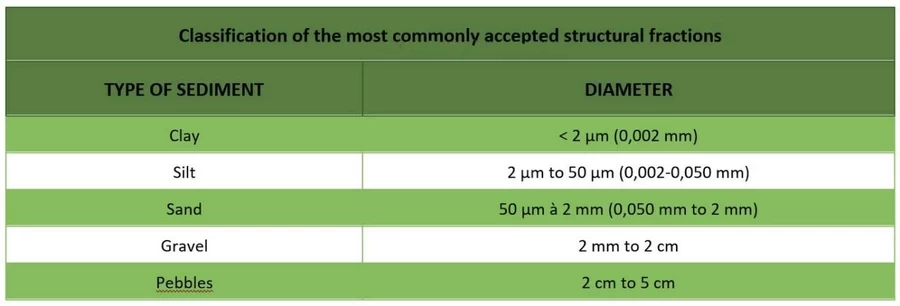
In pedology, texture defines the size of soil minerals by size category, which is more or less related to the chemical composition of these minerals, classified as clays, silts and sands. Organic matter particles, which vary greatly in size, are not included in this definition. The finest particles are mostly clay micelles with a diameter of less than 2 µm. However, more precise analyses show that there are also limestone particles of this size.
Silt particles have a diameter of 50 µm to 2 µm, and those retained for sand are 2 mm to 50 µm. In laboratory analyses, silt and sand particles are often classified into two subcategories based on their diameters. Silt, consisting mainly of fine particles of quartz and feldspar, is the final stage of degradation of parent rock produced by rivers and streams or wind erosion. These silts may contain nutrients for plants (it is known that the silts brought by the periodic flooding of the Nile were the origin of ancient Egyptian civilisation). The composition of sand includes at least 180 minerals from parent rock or living organisms such as shells.
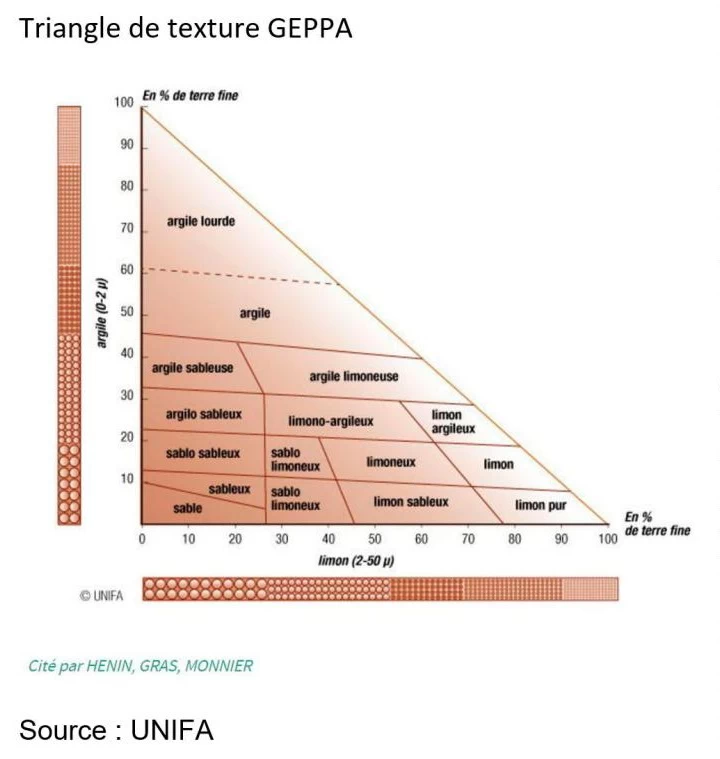
A laboratory performs a granulometric analysis according to a conventional classification after removing particles larger than 2 mm. The analysis report specifies the percentage of these rejects, then the various sediments retained, classified according to particle size from smallest to largest as: clay, fine silt, coarse silt, fine sand and coarse sand. In most cases, you will be given a pie chart with slices specifying the percentage ratio of these different elements.
Structure of cultivated soils
The structure of the soil defines how its constituents, which are not only minerals, organise themselves to form aggregates. For example, a very clayey soil will tend to form compact layers that develop into lamellae after drying. There are two main groups of aggregates: macro-aggregates (> 250 µm) and micro-aggregates (< 250 µm). The combination of these aggregates and coarse elements (gravel, pebbles, large sand particles, shells and other debris) allows the formation of pores containing water and gases. Soil rich in clay, silt and organic matter is characterised by a large number of microspores less than 10 µm in diameter, allowing water and gases to circulate more easily.
In the natural environment or in properly maintained cultivated soil, soil structure is maintained by lombricidae (commonly known as earthworms), which feed on plant debris, and by micro-organisms. Earthworms mainly contribute to aerating the soil, improving water circulation and recycling organic matter. Aerobic bacteria (which require oxygen) responsible for the humification of organic matter play a major role in soil structure (anaerobic bacteria are mainly involved in peat formation processes).
Composition of mineral and organic elements in garden soil
Gardening books commonly describe how garden soil should be composed of mineral and organic elements in proportions that facilitate physical work and the cultivation of many different types of vegetables. According to the 2008 Clause Vilmorin guide, the optimal proportions of elements in growing soil should be close to the following figures: 60 to 70% sand, 15 to 20% clay, 5 to 7% limestone, and the rest humus.
Other texts show comparable proportions comprising coarse and fine silt separated or mixed with other elements, as described in the text on the CFPPAH website for Saint Germain-en-Laye-Chambourcy (65% coarse sand and silt, 15% clay and fine silt, 10% humus, 10% limestone)(1).
As for standard NF U 44-551, it specifies that garden soil must contain 3 to 15% organic matter and a fine fraction of materials with a size of less than 2 mm for 50% of the mass.
Many studies suggest an average of 2 to 4% organic matter for agricultural land, such as that of the Drome Chamber of Agriculture, which also specifies a percentage in relation to clay content, which seems to be a good compromise (see table below).
According to UNIFA, for average soil containing 15 to 20% clay, humus levels should not fall below 2%. “It is possible to have high-quality soil even with moderate MOS levels, as long as sufficient quantities of various residues are regularly present.” (2) – (3) (a).

Source : Analysing your soil to understand it better – Drome Chamber of Agriculture – Nov 2013
a) MOS = stable organic matter.
Why such wide ranges, especially for humus content, which varies significantly from one source to another? It is difficult to reach a consensus on an optimal value for each element that would be valid for everyone, as this value depends in particular on the nature of the crops that the soil must support. Some vegetables thrive in humus-poor soils or require different compositions of sand, clay or limestone.
For example, asparagus and gherkins like sandy soils, garlic is not very demanding in terms of mineral salts, although these must be balanced, and garlic hates soils rich in fresh organic matter. Cucumber cultivation requires substantial fertilisation. It is common to read in organic farming literature that soils well supplied with compost automatically regulate themselves to produce good garden soil, which is not always accurate. The binding of clay with organic matter can be slowed down if the soil is low in iron. Soil that is too wet, poorly drained or low in calcium, even if it receives a lot of organic matter, will eventually become destructured.
Water and gases present in the soil
In well-aerated soil, ¼ of the volume of topsoil is in the form of gas and ¼ is taken up by water. The water present in the soil is never in its pure state. It contains gases and dissolved mineral salts, some of which are nutrients for plants. This water with its dissolved salts is referred to in agronomy and pedology as soil solution.
The gaseous fraction of soil is called the soil atmosphere. Properly aerated soil contains all the gases present in the atmosphere, but in different proportions. The values are approximately as follows: 15% oxygen, 80% nitrogen, 3% CO₂, and about 2% methane and other gases. However, these values may vary depending on the nature of the soil, vegetation cover, seasons, climatic conditions, etc. These gases are largely produced by biological activity in the soil, particularly the decomposition of organic matter by microflora.
Soil compaction
Crusted soil is characterised by surface hardening and reduced porosity. Crusting occurs when rainwater or irrigation water no longer infiltrates the soil. Ploughing is sometimes blamed for this soil change. However, ploughing aerates the soil and reduces compaction, promoting deep water penetration. Topsoil compaction is mainly caused by local geographical conditions, climate, and a lack of sufficient humus and limestone inputs to correct nutrient depletion. This is the case, for example, with soils that are too clayey, even though their structure can be quickly improved by adding lime. Laboratory analyses can determine whether a soil is prone to compaction.
When discussing the causes of soil compaction, it is important to avoid making hasty judgements that do not take local conditions into account. The geographical location of certain fields encourages water accumulation, such as hollow ground located near sloping structures.
Crimping can also be the result of poor natural drainage or caused by infrastructure (agricultural machinery, roads or paths forming a barrier to rainwater runoff, etc.), or by trampling by farm animals, heavy and repeated rainfall, etc. Soil can also naturally contain too much fine silt. Being very light, fine silt tends to rise to the surface, blocking the soil’s porosity and forming a hard crust. It is therefore important to be wary of photos presented on certain websites which, contrary to what their authors claim, do not necessarily reveal hardpan caused by agricultural activities, particularly ploughing.
1) CFPPAH Saint Germain en Laye – cours Bac Pro Travaux Paysagers
2) CSAMR 21-08-2014 Questioning the Value of Soil Quality for the Irrigated Arid West ♦
3) Magdoff et Weil 2004
Laboratory analysis of cultivation soils; next page :